

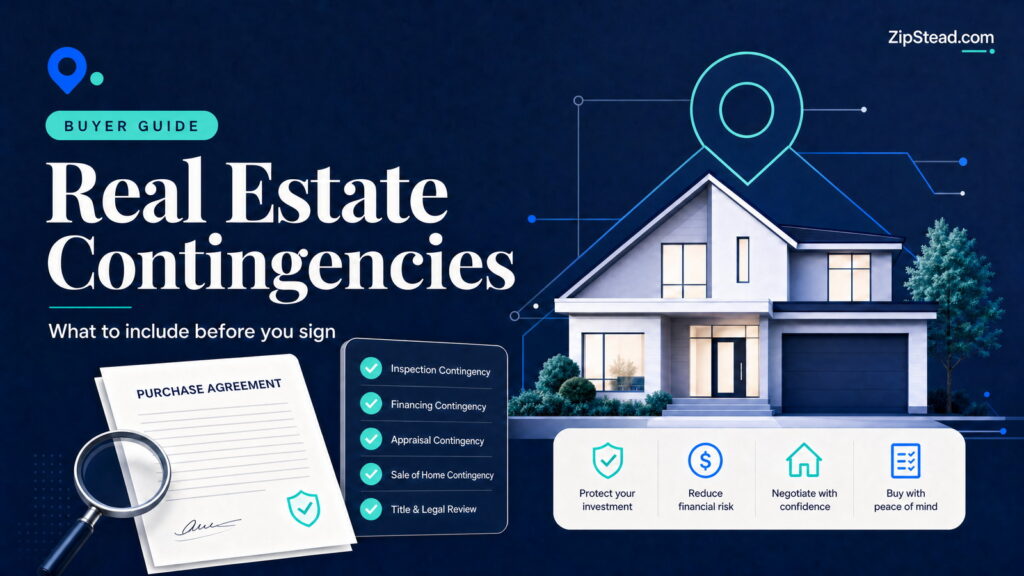
A real estate contingency is a clause in your purchase agreement that gives you a legal exit if specific conditions are not met. Think of contingencies as safety nets — they protect your earnest money deposit and your right to walk away from a deal that goes sideways. In the 2026 housing market, where mortgage rates sit above 6 percent and buyers are regaining some negotiating leverage after years of seller dominance, understanding which contingencies to include in your offer is one of the most important decisions you will make.
This guide covers every major contingency type, explains when to include each one, when it might make sense to waive one, and how contingency strategy has shifted in 2026’s evolving market.
What Is a Real Estate Contingency?
A contingency is a condition written into your purchase contract that must be satisfied before the sale can close. If the condition is not met within the specified timeframe, the buyer can back out of the deal — typically with their earnest money deposit fully refunded.
Every contingency has three components: the condition itself (what must happen), the timeline (how long you have to satisfy or waive it), and the remedy (what happens if the condition is not met). Most contingencies default to allowing the buyer to cancel the contract and recover their deposit, but the specific terms vary based on your state’s standard purchase agreement and any negotiated modifications.
In competitive markets, buyers sometimes waive contingencies to make their offers more attractive. In balanced or buyer-friendly markets, keeping your contingencies intact gives you critical protection. The 2026 market in most areas falls somewhere between these extremes, which makes contingency strategy especially nuanced right now.
The Inspection Contingency
The home inspection contingency is arguably the most important protection in any real estate transaction. It gives you a set window — typically 7 to 14 days after mutual acceptance — to hire a licensed home inspector to evaluate the property’s condition.
After receiving the inspection report, you generally have three options. You can accept the property as-is and proceed with the purchase. You can request that the seller make repairs or provide a credit toward closing costs to offset the issues found. Or you can terminate the contract entirely if the inspection reveals problems you are not willing to accept.
Common issues that come up during inspections include roof damage or aging, foundation cracks or settling, outdated electrical systems, plumbing leaks or galvanized pipes, HVAC systems nearing the end of their useful life, water intrusion or mold, and pest damage. Any of these can cost thousands or tens of thousands of dollars to remediate, which is why the inspection contingency exists.
In 2026, with inventory improving in many markets and fewer bidding wars than the 2021 through 2023 peak, there is rarely a compelling reason to waive your inspection contingency. Even in competitive situations, consider a modified inspection contingency that limits your ability to request minor repairs but preserves your right to cancel for major structural, safety, or mechanical issues. This compromise makes your offer more attractive to sellers while still protecting you from catastrophic surprises.
The Financing Contingency
The financing contingency — also called a mortgage contingency — protects you if your mortgage application is denied or your lender cannot fund the loan by the closing date. This contingency typically gives you 21 to 30 days after mutual acceptance to secure final loan approval.
There are several reasons a mortgage might fall through even after you have a pre-approval letter. Your employment situation could change between pre-approval and closing. The lender might uncover issues during underwriting that were not apparent during pre-approval. Interest rates could spike, pushing your debt-to-income ratio above the lender’s threshold. The property itself might not meet the lender’s requirements due to condition issues, zoning, or title problems.
Without a financing contingency, if your loan falls through for any reason, you could lose your entire earnest money deposit — often 1 to 3 percent of the purchase price. On a $400,000 home, that is $4,000 to $12,000 at risk.
The only scenario where waiving a financing contingency makes sense is if you are paying cash or if you have a guaranteed backup source of funds. For the vast majority of buyers in 2026 who are financing their purchase, keep this contingency in place. No competitive advantage is worth the risk of losing your deposit over a lending decision that is largely outside your control.
The Appraisal Contingency
The appraisal contingency protects you if the home’s appraised value comes in below the agreed purchase price. Mortgage lenders base their loan amount on the appraised value, not the purchase price, which means an appraisal gap can create a sudden and significant financial shortfall.
Here is a practical example. You agree to buy a home for $500,000 with a 20 percent down payment. Your lender approves a loan for 80 percent of the appraised value. If the appraisal comes back at $480,000, your lender will only finance $384,000 (80 percent of $480,000) instead of $400,000. You would need to either cover the $20,000 gap out of pocket, renegotiate the purchase price with the seller, or walk away from the deal.
With an appraisal contingency in place, you can cancel the contract and recover your deposit if the appraisal comes in low and you and the seller cannot reach a revised agreement. Without it, you are contractually obligated to close at the agreed price regardless of the appraisal.
In 2026, appraisal gaps have become less common as the frenzied overbidding of 2021 through 2023 has subsided. Home price appreciation has moderated in many markets, and some areas are seeing slight price declines. That said, appraisal gaps still occur, especially in neighborhoods with limited comparable sales data. Keep this contingency unless you have substantial cash reserves and are comfortable covering a potential gap.
The Home Sale Contingency
The home sale contingency makes your purchase contingent on selling your current home by a specified date. This is common among move-up buyers who need the equity from their existing home to fund the down payment on their next purchase.
From a buyer’s perspective, this contingency is essential if you cannot afford to carry two mortgages simultaneously. However, sellers generally view home sale contingencies unfavorably because they introduce significant uncertainty — your ability to close depends on a separate transaction that the seller has no control over.
In 2026, many sellers will accept a home sale contingency only with a “kick-out clause” that allows them to continue marketing the property and accept backup offers. If another buyer submits a non-contingent offer, you typically have 48 to 72 hours to either waive your contingency and commit to the purchase or release the seller to accept the other offer.
If you need a home sale contingency, strengthen your offer in other areas. A higher earnest money deposit, flexibility on closing dates, or evidence that your current home is already under contract can offset the seller’s concerns about the added risk.
Less Common but Important Contingencies
Title Contingency
The title contingency protects you from purchasing a property with unresolved liens, ownership disputes, easements, or other title defects. During the title search, a title company reviews public records to ensure the seller has clear legal authority to transfer ownership. If title issues are discovered that cannot be resolved, you can cancel the contract.
Most lenders require title insurance regardless, but the title contingency gives you the contractual right to walk away if problems surface. This contingency is standard in most purchase agreements and should never be waived.
HOA Contingency
If you are purchasing a property in a homeowners association, the HOA contingency gives you a review period — typically 3 to 5 days — to examine the HOA’s governing documents, financial statements, meeting minutes, and any pending special assessments or litigation. An HOA with underfunded reserves, ongoing lawsuits, or planned special assessments can cost you thousands in unexpected fees after closing.
Insurance Contingency
Increasingly relevant in 2026, an insurance contingency protects you if you cannot obtain homeowners insurance at a reasonable cost. With climate-related risks driving up insurance premiums in many parts of the country — particularly in wildfire-prone areas of the West and hurricane-exposed coastal regions — some buyers are discovering that insurance costs make an otherwise affordable home unaffordable. This contingency allows you to exit the deal if adequate coverage is not available or is prohibitively expensive.
Contingency Strategy in the 2026 Market
The 2026 market has shifted meaningfully from the extreme seller’s market of 2021 through 2023. Inventory is rising, days on market are increasing, and buyers have more negotiating power than they have had in years. Here is how to think about contingency strategy in the current environment.
In most markets, keep all your standard contingencies. The inspection, financing, appraisal, and title contingencies should be part of every offer unless you have a very specific reason to waive one. The days of waiving contingencies just to compete are largely over in most areas.
If you are in a still-competitive market or making an offer on a highly desirable property, consider a modified approach rather than full waivers. A shortened inspection period (7 days instead of 14) shows good faith while preserving your protection. An appraisal gap guarantee of a specific dollar amount (say, up to $10,000) signals seriousness without unlimited risk. A pre-inspection before making your offer eliminates the need for an inspection contingency entirely because you already know the home’s condition.
Work closely with your real estate agent to calibrate your contingency strategy to your specific market conditions. What works in a cooling market like Austin may be too aggressive for a still-tight market like Nashville.
Protecting Yourself Without Losing the Deal
The most common mistake buyers make with contingencies is thinking in binary terms — either include them all or waive them all. Smart buyers in 2026 take a more nuanced approach.
Get pre-underwritten, not just pre-approved. Full underwriting upfront means your financing contingency becomes almost a formality, making sellers more comfortable with it. Bring a larger earnest money deposit. Offering 2 to 3 percent instead of the standard 1 percent signals confidence and commitment. Be responsive and communicative. Sellers worry about contingencies because they fear delays and uncertainty. Moving quickly through your contingency periods and communicating clearly reduces that anxiety.
Your earnest money is not just a deposit — it is money you could lose if you waive protections and the deal goes wrong. Approach every contingency decision by asking yourself: if the worst-case scenario happens, can I afford the financial consequence of not having this protection? If the answer is no, keep the contingency.
What Sellers Should Know About Contingencies
If you are on the selling side of the transaction, understanding contingencies helps you evaluate offers more effectively. An offer with all standard contingencies and a strong pre-approval letter from a reputable lender may actually be more likely to close than a higher-priced offer with waived contingencies from a buyer who is stretching financially.
Pay attention to the timelines in each contingency. Shorter inspection and financing windows mean less time your home sits in a contingent status. Ask your agent about the buyer’s lender reputation and track record — some lenders close reliably in 21 days while others routinely cause delays.
In a 2026 market with more balanced conditions, accepting reasonable contingencies and focusing on the overall strength of the offer (price, down payment, lender quality, closing timeline) will serve you better than chasing the highest price from a risky buyer.
Making Your Decision
Every home purchase is different, and the right contingency strategy depends on your financial situation, risk tolerance, and local market conditions. The safest approach for most buyers in 2026 is to include the inspection, financing, appraisal, and title contingencies as a baseline, and only modify or waive specific contingencies when you have a clear strategic reason and can absorb the financial risk.
If you are unsure which contingencies to include in your offer, talk to a knowledgeable real estate agent who can walk you through the trade-offs based on the specific property and market you are dealing with. A few hundred dollars in inspection or appraisal costs is always worth the peace of mind and legal protection these contingencies provide.